✓ Board-verified
Chemistry · 2024 · 5 marks
Aldehydes, Ketones and Carboxylic AcidsChemical Reactions of Aldehydes, Ketones and Carboxylic Acids5 marksApplylong answer
CBSE 2024 · Region 3 · Set 1 · Q32
(a) (i) Write the major product(s) in the following reactions: (2) (3) (ii) Give simple chemical tests to distinguish between the following pairs of…
(i)
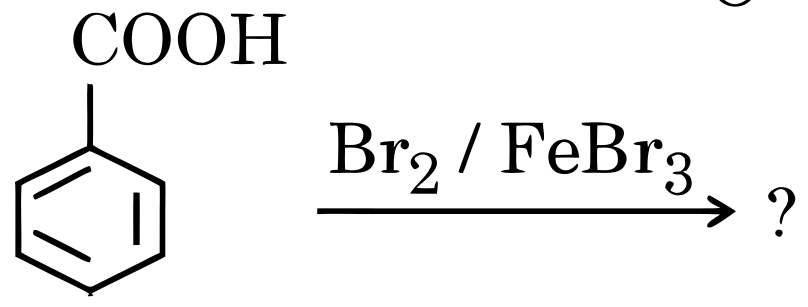
Write the major product(s) in the following reactions :

(2)
(3)
(ii)
Give simple chemical tests to distinguish between the following pairs of compounds :
(1)
and
(2)
Pentanal and Pentan-$\displaystyle 3$-one
(i)
Give reasons for the following :
(1)
In semicarbazide, only one $\displaystyle -\mathrm{NH}_{2}$ group is involved in the formation of semicarbazone.
(2)
Acetaldehyde is more reactive than acetone towards addition of HCN.
(ii)(1)
Arrange the following in decreasing order of their acidic strength : $\displaystyle \mathrm{CH}_{3} \mathrm{COOH}, \quad \mathrm{O}_{2} \mathrm{~N}-\mathrm{CH}_{2}-\mathrm{COOH}, \quad \mathrm{HCOOH}$
(2)
Name the reagent in the following reaction : \[\begin{aligned} \mathrm{CH}_{3}-\mathrm{CH}=\mathrm{CH}- & \mathrm{CH}_{2}-\mathrm{CN} \xrightarrow{?} \\ & \mathrm{CH}_{3}-\mathrm{CH}=\mathrm{CH}-\mathrm{CH}_{2}-\mathrm{CHO} \end{aligned} \]
(iii)
Write the reaction involved in Hell-Volhard-Zelinsky reaction.
Marking-scheme solution
(b)(i)
(1)
Because one - \(\displaystyle \mathrm{NH}_{2}\) group adjacent to carbonyl group is involved in resonance with it .
(2)
Steric and electronic reasons / In acetone two alkyl groups reduce the electrophilicity of the carbonyl carbon more effectively than in acetaldehyde.
(ii) ($\displaystyle 1$) \(\displaystyle \mathrm{O}_{2} \mathrm{~N}-\mathrm{CH}_{2} \mathrm{COOH}>\mathrm{HCOOH}>\mathrm{CH}_{3} \mathrm{COOH}\)
(2) DIBAL H / H2O
(iii)
\(\displaystyle \mathrm{X}=\mathrm{Cl}, \mathrm{Br}\)
All Aldehydes, Ketones and Carboxylic Acids questions2024 question paperNCERT solutions: Aldehydes, Ketones and Carboxylic AcidsPractice Aldehydes, Ketones and Carboxylic Acids →
More from Aldehydes, Ketones and Carboxylic Acids
- Write the equation involved in the following reactions: (i) Rosenmund reduction (ii) Etard reaction (iii) Stephen reaction OR (i) Which acid of each…2022
- Draw the structures of product(s) in each of the following reactions:2025
- The acid formed when propyl magnesium bromide is treated with CO_2 followed by acid hydrolysis is:2025
- (i) Identify A, B and C in the following reactions: (ii) Give reasons for the following: (I) Carboxylic acids do not give the characteristic…2025
- Write the products formed in the following reactions: CH_3 CHO+NH_2 CONHNH_2 → 1 CH_3 CHO → dil. NaOH 1 CH_3 COOH →[H_2 O]Cl_2 / redP2025
- Give a simple chemical test to distinguish between 3-pentanone and 2-pentanone. Write an equation for Clemmensen reduction.2025
- This reaction is known as:2023
- Give chemical tests to distinguish between the following pairs of compounds: (i) Phenol and Benzoic acid (ii) Propanal and Propanone Which one of the…2024
CBSE Class 12 Chemistry past-paper question from the 2024 board exam, with the answer as CBSE’s own marking scheme gives it. Where our answers come from.