✓ Board-verified
Chemistry · 2026 · 5 marks
Haloalkanes and HaloarenesChemical Reactions of Haloalkanes and Haloarenes5 marksUnderstandlong answer
CBSE 2026 · Region 5 · Set 1 · Q33
(a) (i) (I) Which of the following is more reactive towards S_N 1 reaction: 2-Bromo-2-methylbutane or 1-Bromopentane (II) What type of halide is…
(i)
(I)
Which of the following is more reactive towards $\displaystyle \mathrm{S}_{\mathrm{N}} 1$ reaction : $\displaystyle 2$-Bromo-$\displaystyle 2$-methylbutane or $\displaystyle 1$-Bromopentane
(II)
What type of halide is present in the following compound :
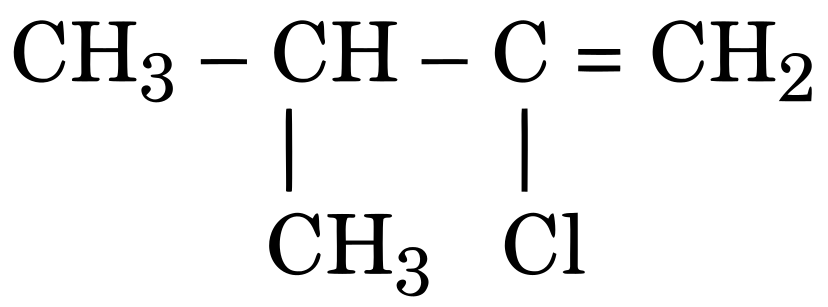
(III)
Why is chloroform stored in dark coloured bottles ?
(ii)
Define the following terms :
(I)
Ambident Nucleophiles
(II)
Racemic mixture
(i)
Answer the following :
(I)
Which isomer of $\displaystyle \mathrm{C}_{4} \mathrm{H}_{9} \mathrm{Br}$ is most reactive towards $\displaystyle \mathrm{S}_{\mathrm{N}} 1$ reaction?
(II)
Predict the alkene that would be formed by dehydrohalogenation of $\displaystyle 1$-Bromo-$\displaystyle 1$-methylcyclohexane.
(III)
Although chlorine shows strong - I effect, yet it is ortho/para-directing in electrophilic aromatic substitution reactions. Why ?
(ii)
Write the major product in the following reactions :
(I)
(II)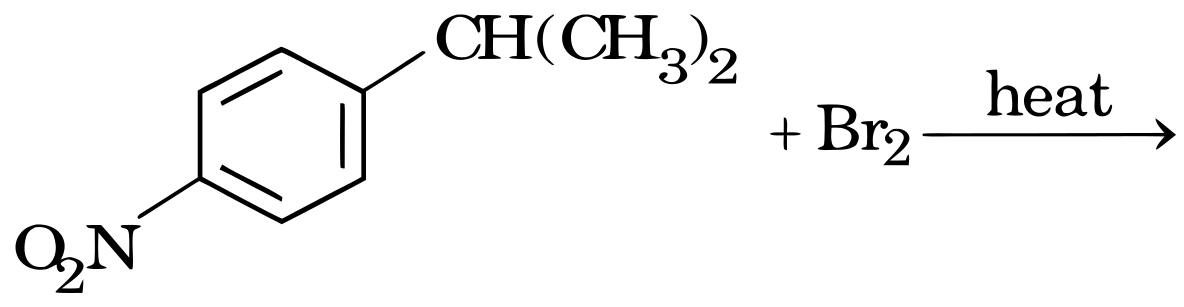
Marking-scheme solution
(i)
(I)
$\displaystyle 2$-Bromo-$\displaystyle 2$-methylbutane
(II)
Vinylic halide
(III)
It is slowly oxidised in presence of light to give poisonous gas
phosgene/
2CHCl3 + O2 $\displaystyle \xrightarrow{\text{light}}$ 2COCl2 + 2HCl
(ii)
(I)
Groups having two nucleophilic centres.
(II)
Equal amounts of dextro and laevo enantiomers in a mixture.
(i)
(I)
Tert-butyl bromide / (CH3)3C−Br / $\displaystyle 2$-Bromo-$\displaystyle 2$-methylpropane
(II)
or

(III)
Because +R effect stabilises the intermediate carbocation.
(ii)
(I)
(II)
All Haloalkanes and Haloarenes questions2026 question paperNCERT solutions: Haloalkanes and HaloarenesPractice Haloalkanes and Haloarenes →
More from Haloalkanes and Haloarenes
- Why haloarenes are not reactive towards nucleophilic substitution reaction? Give two reasons.2023
- Account for the following: 1 × 3 Haloalkanes react with NaCN to form both cyanides and isocyanides. Haloarenes do not undergo nucleophilic…2024
- Reaction of 1-phenyl-2-chloropropane with alcoholic KOH gives mainly:2023
- The species that attacks benzene in following is:2023
- Write the major product in the following reactions: 1+1+1 Define Racemic mixture. p-dichlorobenzene has a higher melting point as compared to its…2026
- In the following pair of compounds, which compound undergoes S_N 1 reaction faster and why? OR Write the major product in the following:2024
- Write the IUPAC name of the given compound: Why are haloalkanes more reactive towards nucleophilic substitution reactions than haloarenes? What…2024
- Assertion: Bromination of benzoic acid gives m-bromobenzoic acid. Reason (R): Carboxyl group increases the electron density at the meta position.2023
CBSE Class 12 Chemistry past-paper question from the 2026 board exam, with the answer as CBSE’s own marking scheme gives it. Where our answers come from.