✓ Board-verified
Chemistry · 2026 · 5 marks
Aldehydes, Ketones and Carboxylic AcidsChemical Reactions of Aldehydes, Ketones and Carboxylic Acids5 marksApplylong answer
CBSE 2026 · Region 2 · Set 1 · Q31
(A) (a) How will you convert the following: 3 + 2 (i) Propanone to Propene (ii) Benzoic acid to Benzaldehyde (iii) Benzene to m-Nitroacetophenone (b)…
(a)
How will you convert the following : $\displaystyle 3$ + $\displaystyle 2$
(i)
Propanone to Propene
(ii)
Benzoic acid to Benzaldehyde
(iii)
Benzene to m-Nitroacetophenone
(b)(i)
Arrange the following compounds in increasing order of their reactivity towards HCN :
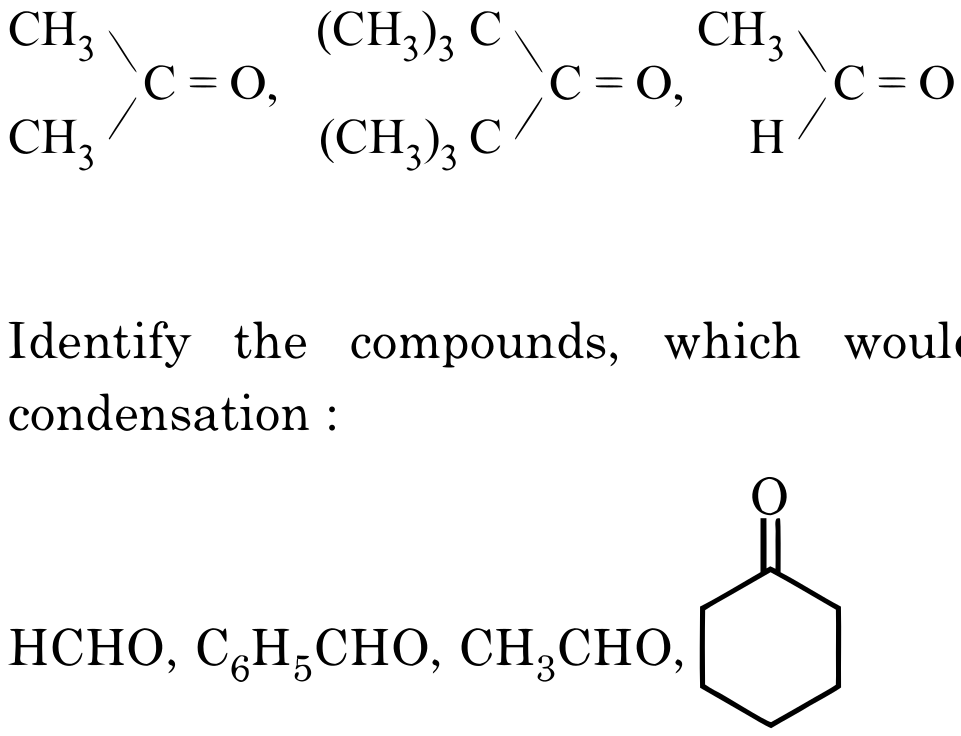
(ii)
Identify the compounds, which would undergo Aldol condensation : $\displaystyle \mathrm{HCHO}, \mathrm{C}_{6} \mathrm{H}_{5} \mathrm{CHO}, \mathrm{CH}_{3} \mathrm{CHO}$,
(a)
Give chemical tests to distinguish between the following pairs of compounds : $\displaystyle 3$ + $\displaystyle 2$
(i)
Acetophenone and Benzophenone
(ii)
Propanal and Propanone
(iii)
Pentan-$\displaystyle 2$-one and Pentan-$\displaystyle 3$-one
(b)(i)
Which of the following acids is stronger and why ? $\displaystyle \mathrm{CH}_{2} \mathrm{FCOOH}, \mathrm{CH}_{3} \mathrm{COOH}$
(ii)
Arrange the following compounds in the increasing order of their boiling points : $\displaystyle \mathrm{CH}_{3} \mathrm{OCH}_{3}, \mathrm{CH}_{3} \mathrm{CH}_{2} \mathrm{CH}_{3}, \mathrm{CH}_{3} \mathrm{CH}_{2} \mathrm{OH}, \mathrm{CH}_{3} \mathrm{CHO}$
Marking-scheme solution
.
(a) (i)

(ii)
(iii)

(b)(i)
(ii)
.
(a)(i) Acetophenone on heating with NaOH and I2, gives yellow precipitate of
iodoform whereas benzophenone does not give iodoform test.
(ii)
Propanal reduces Tollens’ reagent to silver whereas propanone does not.
(iii)
Pentan-$\displaystyle 2$-one on heating with NaOH and I2, gives yellow precipitate of
iodoform whereas Pentan-$\displaystyle 3$-one does not.
(b)(i)
FCH2COOH is a stronger acid than CH3COOH.
Due to – I effect of F atom
(ii)
CH3CH2CH3 < CH3OCH3 < CH3CHO < CH3CH2OH
All Aldehydes, Ketones and Carboxylic Acids questions2026 question paperNCERT solutions: Aldehydes, Ketones and Carboxylic AcidsPractice Aldehydes, Ketones and Carboxylic Acids →
More from Aldehydes, Ketones and Carboxylic Acids
- Write the equation involved in the following reactions: (i) Rosenmund reduction (ii) Etard reaction (iii) Stephen reaction OR (i) Which acid of each…2022
- Draw the structures of product(s) in each of the following reactions:2025
- The acid formed when propyl magnesium bromide is treated with CO_2 followed by acid hydrolysis is:2025
- (i) Identify A, B and C in the following reactions: (ii) Give reasons for the following: (I) Carboxylic acids do not give the characteristic…2025
- Write the products formed in the following reactions: CH_3 CHO+NH_2 CONHNH_2 → 1 CH_3 CHO → dil. NaOH 1 CH_3 COOH →[H_2 O]Cl_2 / redP2025
- Give a simple chemical test to distinguish between 3-pentanone and 2-pentanone. Write an equation for Clemmensen reduction.2025
- This reaction is known as:2023
- Give chemical tests to distinguish between the following pairs of compounds: (i) Phenol and Benzoic acid (ii) Propanal and Propanone Which one of the…2024
CBSE Class 12 Chemistry past-paper question from the 2026 board exam, with the answer as CBSE’s own marking scheme gives it. Where our answers come from.