✓ Board-verified
Biology · 2024 · 5 marks
CBSE 2024 · Region 4 · Set 1 · Q31
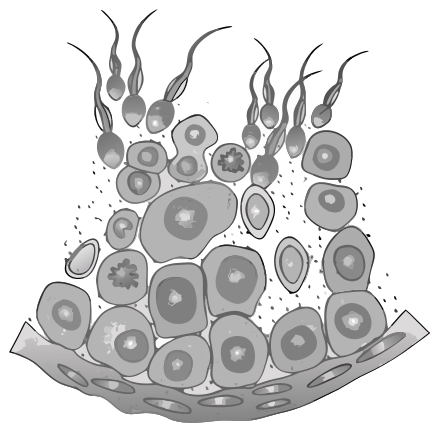
(a) The given diagram shows the sectional view of a seminiferous tubule of Human testis: (i) Name and describe the process depicted in the diagram…
The given diagram shows the sectional view of a seminiferous tubule of Human testis:
(i)
Name and describe the process depicted in the diagram which results in the development of spermatozoa.
(ii)
Identify the cell where you are seeing a cluster of spermatozoa attached in the diagram. Write the function of the cell.

Observe the picture of Commelina plant bearing two types of flowers given above.
(i)
Identify the two types of flowers labelled 'A' and 'B' in the picture.
(ii)
Compare the two types of flowers with reference to :
(1)
Characteristic feature
(2)
modes of pollination
(iii)
List any two 'out breeding devices' in flowering plants. Explain why do plants develop such devices.
Marking-scheme solution
(a)
(i)
Spermatogenesis
Spermatogonia → Mitosis / differentiation → Primary spermatocytes → 1st meiotic division → Secondary spermatocytes → 2nd meiotic division → Spermatids → Differentiation / spermiogenesis → Spermatozoa
(ii)
Sertoli cells, provides nourishment to the developing sperm.
(i)
A- chasmogamous flower
B- cleistogamous flower
(ii)
‘A’
‘B’
(1) open flower / blossom
closed flower/ Do not
blossom
(2)
Autogamy as well as
geitonogamy and
xenogamy/cross
pollination
only autogamy/self-
pollination
(iii)
•
In some species, pollen release and stigma receptivity are not
synchronized. Either the pollen is released before the stigma becomes
receptive or stigma becomes receptive much before the release of pollen.
The anther and stigma are placed at different positions so that the pollen
cannot come in contact with the stigma of the same flower.
Self-incompatibility. This is a genetic mechanism and prevents self-
pollen from fertilizing the ovules.
Production of unisexual flowers.
•
To prevent inbreeding depression/ to discourage self-pollination and to encourage cross pollination/ to develop genetic variation
All Human Reproduction questions2024 question paperNCERT solutions: Human ReproductionPractice Human Reproduction →
More from Human Reproduction
- Colostrum secreted by the mother's mammary glands in a human female during the initial days of lactation is rich in antibody:2025
- Which of the following options correctly matches the name of the hormone to its site of production in the human body?2023
- (i) Describe the events of spermatogenesis with the help of a A schematic diagram. (ii) Explain the role of hormones in spermatogenesis. OR (i) Show…2024
- Given below are few statements with reference to the human male reproductive system. (i) Paired seminal vesicles, prostate gland and bulbourethral…2025
- Given below are a few statements with reference to the human sperm. (i) Sperm head contains a large nucleus and a lot of cytoplasm. (ii) Mitochondria…2025
- Which of the following hormones is not secreted by the human placenta?2023
- Explain the neuroendocrine mechanism involved in the process of parturition in a human female leading to the expulsion of the baby out of the uterus…2025
- Given below are structural details of a human mammary gland: 1 (i) The glandular tissue in the breast has 15-20 clusters of cells called alveoli.…2023
CBSE Class 12 Biology past-paper question from the 2024 board exam, with the answer as CBSE’s own marking scheme gives it. Where our answers come from.