✓ Board-verified
Biology · 2025 · 5 marks
Sexual Reproduction in Flowering PlantsPre-fertilisation: Structures and Events5 marksAnalyselong answer
CBSE 2025 · Region 1 · Set 1 · Q32
Student to attempt either option-(A) or (B): (A) (a) Distinguish between the two cells enclosed in a mature male gametophyte of an angiosperm. (b)…
Student to attempt either option-(A) or (B) :
(a)
Distinguish between the two cells enclosed in a mature male gametophyte of an angiosperm.
(b)
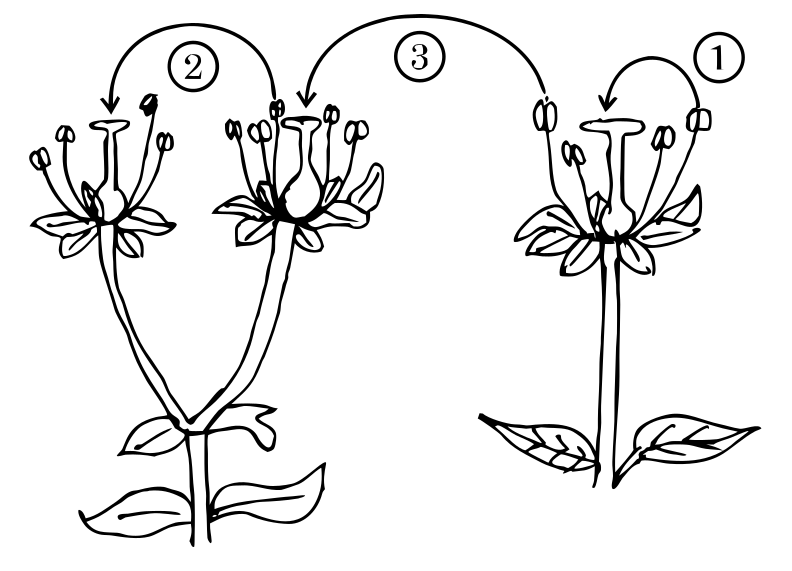
Study the diagram given below showing the modes of pollination. Answer the questions that follow.
(i)
The given diagram shows three methods of pollen transfer in plants. Examine them carefully and write the technical terms used for pollen transfer methods '$\displaystyle 1$', '$\displaystyle 2$' and '$\displaystyle 3$'.
(ii)
How do the following plants achieve pollination successfully ?
(a)
Water lily
(b)
Vallisneria
(iii)
Write advantages of pollen transfer in method '$\displaystyle 3$'.
Given below is the diagram of human ovum surrounded by a few sperms. Observe the diagram and answer the questions that follows :

(i)
Compare the fate of sperms 'P', 'Q' and 'R' shown in the diagram.
(ii)
Write the role of Zona pellucida in this process.
(iii)
Analyse the changes occurring in the ovum after the entry of sperm.
(iv)
How acrosome and middle piece of a human sperm are able to play an important role in human fertilization ?
Marking-scheme solution
(a)
| Vegetative cell | Generative cell |
| It is big with abundant food reserve and an irregular shaped nucleus | Generative cell is small, floats in the cytoplasm of the vegetative cell |
| Helps in the formation of pollen tube | Forms two male gametes |
(b)(i)
$\displaystyle 1$ = Autogamy
$\displaystyle 2$ = Geitonogamy
$\displaystyle 3$ = Xenogamy
(ii)
a = by Insects or wind
b = by Water
(iii)
Genetic variation, Healthier offspring,Elimination of recessive traits, Disease resistance ,Evolution, no inbreeding depression, promotes heterosis
(i)
P is able to penetrate or fertilise the ovum ,whereas Q and R are unable to penetrate or fertilise.
(ii)
When a sperm comes in contact with the zona pellucida layer of the ovum it induces changes in the membrane that blocks the entry of additional sperms.
(iii)
Entry of sperm induces completion of meiotic division of the secondary oocyte and formation of second polar body and a haploid ovum (ootid)
(iv)
Acrosome : It is filled with the enzyme which helps the sperm to enter into the cytoplasm of the ovum
Middle piece : It has numerous mitochondria which produce energy for the movement of tail that facilitate sperm motility for fertilisation
All Sexual Reproduction in Flowering Plants questions2025 question paperNCERT solutions: Sexual Reproduction in Flowering PlantsPractice Sexual Reproduction in Flowering Plants →
More from Sexual Reproduction in Flowering Plants
- Choose the option that gives the correct number of pollen grains that will be formed after 325 microspore mother cells undergo microsporogenesis.2026 · asked 2×
- In which one of the following floral plants are many embryos formed in the seeds without fertilisation of the egg cell?2024
- Explain the process of the development of a male gametophyte in an angiosperm. Why is it called a male gametophyte?2023
- In angiosperms, the female gametophyte develops from a single cell of megasporangium. (i) Name that cell of megasporangium and describe the…2026
- Some flowers are unisexual, this property of unisexuality of flowers prevents which kind of pollination?2025
- The ploidy of apomictic embryos developing from the nucellus and antipodal cells respectively would be:2024
- Given below are stages of embryo sac formation from megaspore mother cell. Identify the correct option for the cell division marked a, b, c and d.2026
- Draw a T.S. of a mature anther of an angiosperm. Label its any three wall layers and mention their functions.2024
CBSE Class 12 Biology past-paper question from the 2025 board exam, with the answer as CBSE’s own marking scheme gives it. Where our answers come from.