✓ Board-verified
Biology · 2024 · 4 marks
CBSE 2024 · Region 1 · Set 1 · Q29
Read the following passage and answer the questions that follow. Isn't it incredible that India's land area is only 2 · 4 per cent of the world's…
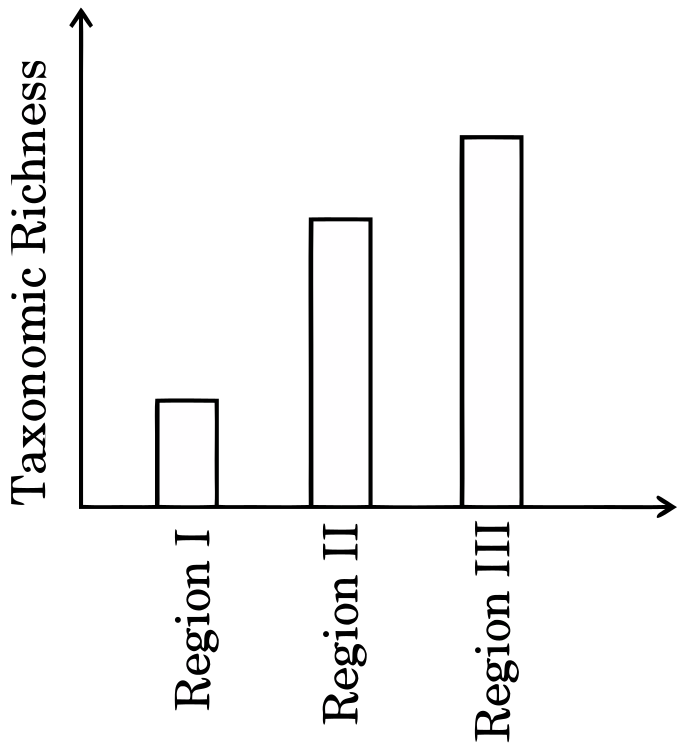
Read the following passage and answer the questions that follow. Isn't it incredible that India's land area is only $\displaystyle 2 \cdot 4$ per cent of the world's total land area whereas its share of the global species diversity is an impressive $\displaystyle 8 \cdot 1$ per cent ! However, in these estimates of species, prokaryotes do not figure anywhere. Biologists are always keen on collecting data with respect to species diversity observed in different regions of the world. The data collected based on the survey conducted for species richness of groups of mammals in three different regions of the world is shown in the bar graph given below :
(a)
Why is the species richness maximum in Region III in the bar graph ?
OR
(a)
Why is the species richness minimum in Region I in the bar graph ?
(b)
Plants and animals do not have uniform diversity in the world but show rather uneven distribution. Mention what this kind of diversity is referred to as.
(c)
Why is it that prokaryotes do not have an estimated number of their species diversity as seen in plants and animals ? Explain.
Marking-scheme solution
This region is less seasonal with constant and more predictable environment / More solar energy so higher productivity and higher diversity / it represent tropical lattitudes which remain relatively undisturbed for millions of years and had a long evolutionary time for species diversification .
Region I represent temperate region subjected to frequent glaciation and get lesser evolutionary time for species diversification / has more seasonal with less constant and less predictable environment which lead to lower specie diversification / have lower solar energy available which reduces productivity and inturn contributes to lesser diversity.
(b)
Latitudinal gradient in diversity
(c)
Conventional taxonomic methods are not suitable for identifying microbial species, and many species are not culturable under laboratory conditions.
All Biodiversity and Conservation questions2024 question paperNCERT solutions: Biodiversity and ConservationPractice Biodiversity and Conservation →
More from Biodiversity and Conservation
- Enlist two criteria that are used to identify a region for maximum protection as 'Biodiversity hotspots'. Name any two "hotspot" regions in our…2022
- Exploration of molecular, genetic and species level diversity for gaining products of economic importance is called2026
- Given below is an equation describing the Species-Area relationship between species richness and area for a wide variety of taxa as angiosperm…2022
- How are 'in-situ' and 'ex-situ' approaches of biodiversity conservations different from each other?2022
- Given below is a pie chart representing global diversity of vertebrates. Redraw the pie chart identifying the groups 'A', 'B', 'C' and 'D' in their…2024
- According to a recent wildlife report, the biggest threat to the tiger's survival in Mudumalai Tiger Reserve (MTR) was found to be a small, beautiful…2025
- India has only 2.4% of the world's land area but its share of the global species diversity is:2025
- "Abingdon tortoise in Galapagos islands became extinct within a decade on introduction of goats in the island." Explain giving reason.2023
CBSE Class 12 Biology past-paper question from the 2024 board exam, with the answer as CBSE’s own marking scheme gives it. Where our answers come from.