✓ Board-verified
Biology · 2026 · 4 marks
CBSE 2026 · Region 3 · Set 1 · Q30
Read the following passage and answer the questions that follow: India is one of the megadiverse countries housing around 8⋅1 per cent of global…
Read the following passage and answer the questions that follow : India is one of the megadiverse countries housing around $\displaystyle 8$⋅$\displaystyle 1$ per cent of global species diversity, although its land area is only $\displaystyle 2 \cdot 4$ per cent of the world's land area. Many of the species are highly threatened due to human activities like deforestation, mining and habitat fragmentation. Laws like Wildlife (Protection) Act, $\displaystyle 1972$ were enacted by the Government of India to preserve our biological wealth. Various conservation measures are being implemented to save the threatened species. The following bar graph shows the number of species conserved under different biodiversity conservation methods.
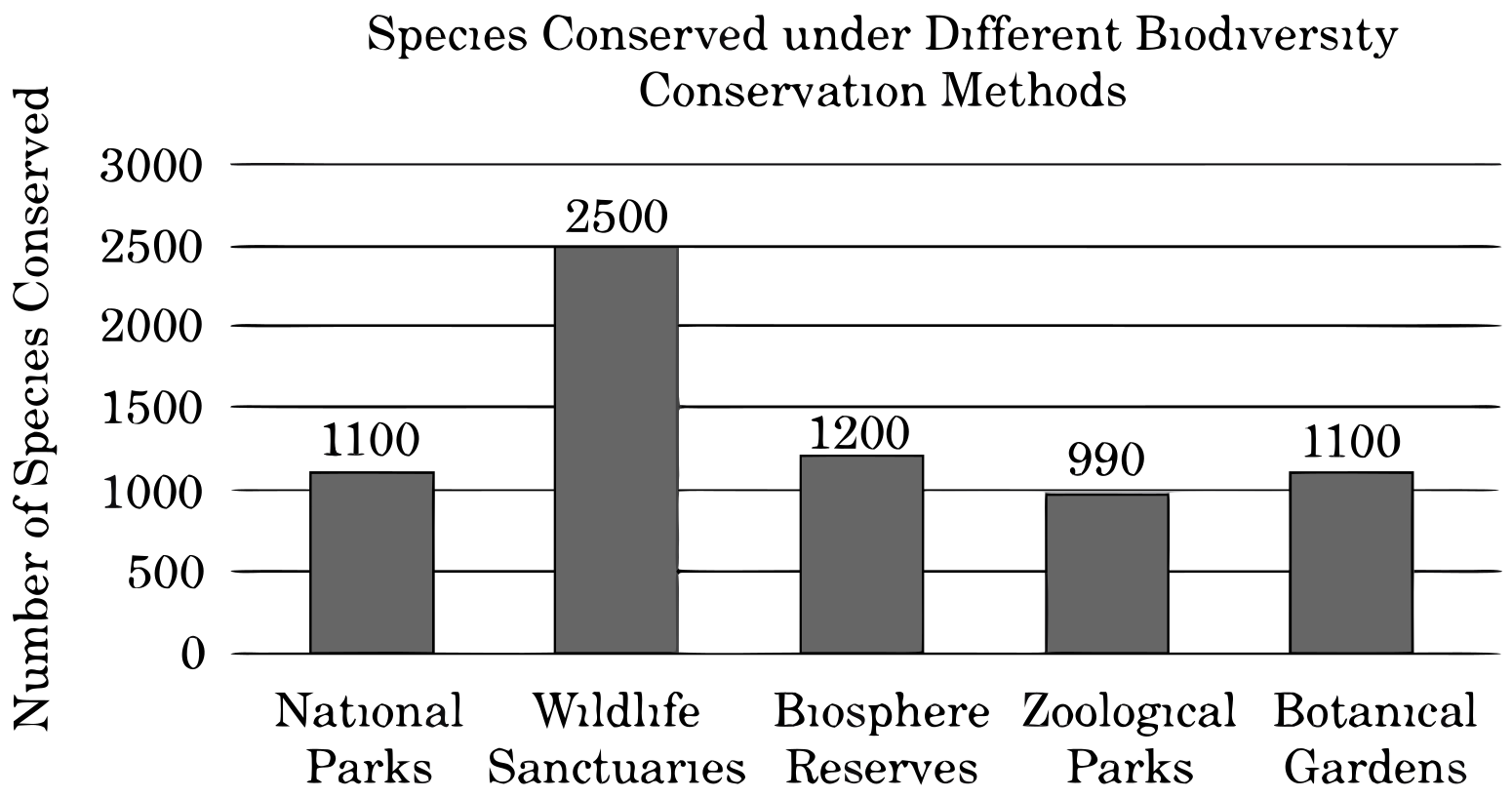
Conservation Method Study the graph and answer the questions.
(a)
Which method conserves the highest number of species ? Is it ex situ or in situ conservation?
(b)
Which other methods shown in the diagram are opposite to the one identified by you in question (a) ? How are these two conservation approaches different ?
(c)(i)
Write two features of Biodiversity hotspots.
OR
(c)
(ii)
To which category do sacred groves belong and how do they help in bio-conservation ?
Marking-scheme solution
(a)
Wild life sanctuaries conserve highest number of species, In-situ conservation.
(b)
Zoological Parks and Botanical Gardens are different, They are ex-situ
In situ Conservation
Ex- Situ Conservation
1) Conserves the whole ecosystem
and biodiversity at all levels is protected.
Conserves animals or plants that are endangered/threatened and given urgent measures to save them from extinction.
2) Organisms are protected in their
natural habitat.
Organisms are taken out from their natural habitat and placed in special settings where they can be protected and given special care.
(c)
(i)
High level of species richness, high degree of endemism
OR
(ii)
In- situ Conservation.
The tracts of forests were set aside and all trees and wild life within were venerated and given total protection.
All Biodiversity and Conservation questions2026 question paperNCERT solutions: Biodiversity and ConservationPractice Biodiversity and Conservation →
More from Biodiversity and Conservation
- Enlist two criteria that are used to identify a region for maximum protection as 'Biodiversity hotspots'. Name any two "hotspot" regions in our…2022
- Exploration of molecular, genetic and species level diversity for gaining products of economic importance is called2026
- Given below is an equation describing the Species-Area relationship between species richness and area for a wide variety of taxa as angiosperm…2022
- How are 'in-situ' and 'ex-situ' approaches of biodiversity conservations different from each other?2022
- Given below is a pie chart representing global diversity of vertebrates. Redraw the pie chart identifying the groups 'A', 'B', 'C' and 'D' in their…2024
- According to a recent wildlife report, the biggest threat to the tiger's survival in Mudumalai Tiger Reserve (MTR) was found to be a small, beautiful…2025
- India has only 2.4% of the world's land area but its share of the global species diversity is:2025
- "Abingdon tortoise in Galapagos islands became extinct within a decade on introduction of goats in the island." Explain giving reason.2023
CBSE Class 12 Biology past-paper question from the 2026 board exam, with the answer as CBSE’s own marking scheme gives it. Where our answers come from.