✓ Board-verified
Biology · 2023 · 5 marks
CBSE 2023 · Region 1 · Set 1 · Q32
(a) A time-bound vaccination programme is followed for the children in our country from their birth up to ten years of age. A graph plotted below…
A time-bound vaccination programme is followed for the children in our country from their birth up to ten years of age. A graph plotted below shows the effect of the vaccination followed by infection by the same pathogen, and the antibody concentration in the blood of the child.
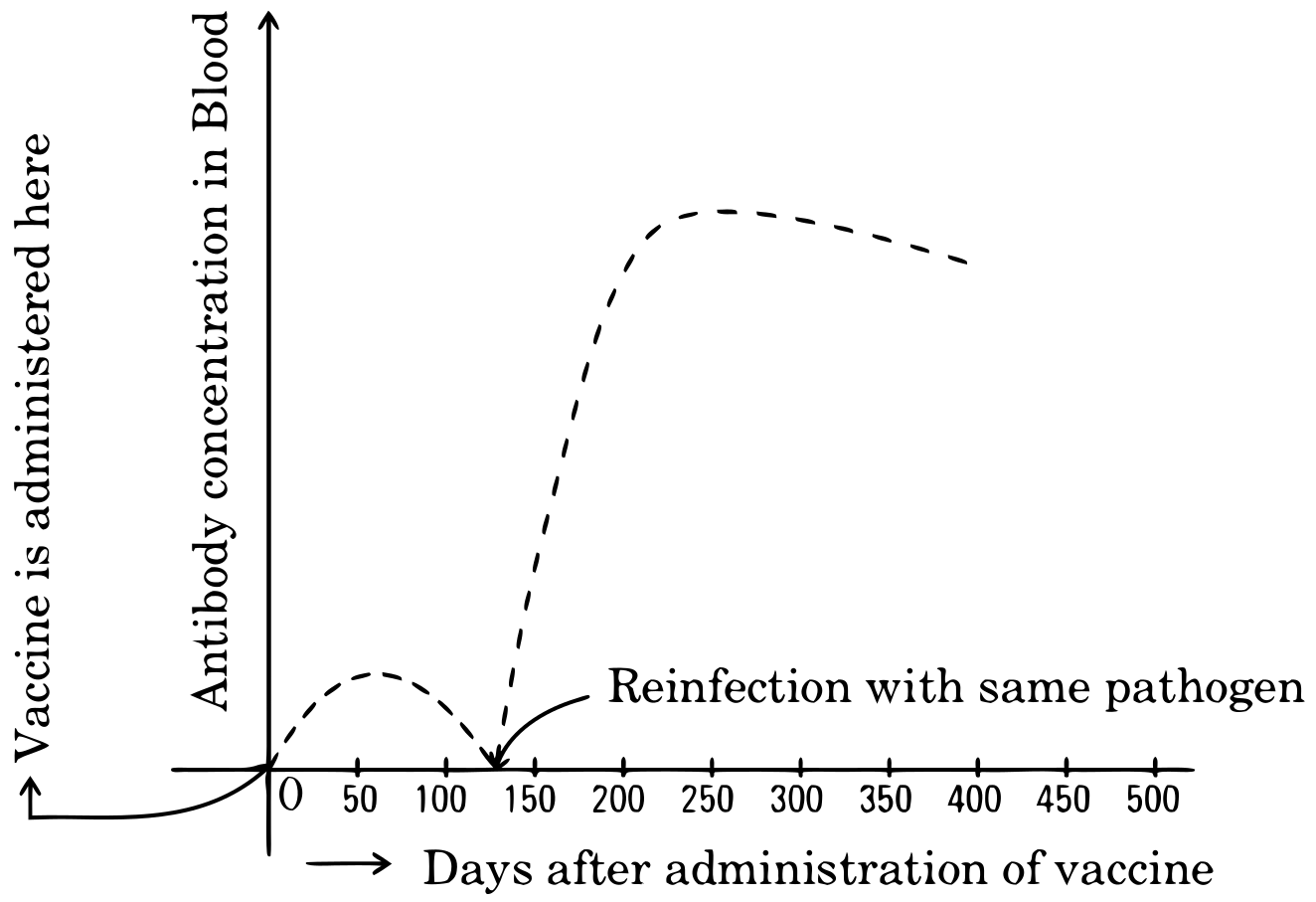
(i)
Explain why the administration of a vaccine causes an increase in the antibody concentration.
(ii)
If the child is infected with the same pathogen almost four months later, the antibody concentration in his/her blood increases very fast. Explain why.
(iii)
A table given below gives information about different types of immunity and how they are attained. Identify 'P', 'Q', 'R', 'S' and ' T ' in the table.
| Type of immunity | Production of antibodies | Presence of memory cells | Mode attained | |
| ($\displaystyle 1$) | Natural, active | Yes | 'P' | 'Q' |
| ($\displaystyle 2$) | Natural, passive | No | 'R' | Across the placenta during pregnancy/breast feeding |
| ($\displaystyle 3$) | Acquired, active | 'S' | Yes | Getting a vaccine during breast feeding |
| ($\displaystyle 4$) | Acquired, passive | 'T' | No | Getting an injection of antibodies |
(i)
What is the chemical name of 'smack'? Why is the consumption of smack considered as an abuse ?
(ii)
Name the source plant and one effect of the following drugs on the human body :
(1)
Marijuana
(2)
Cocaine
(3)
Morphine
Marking-scheme solution
(i)
The vaccine contains the antigen, which stimulates or activates immune cells to produce antibodies (by B lymphocytes) / which generates primary response or humoral immune response.
(ii)
Memory cells generate, amnestic response/secondary response
(iii)
\[\begin{aligned}
& \mathrm{P}=\mathrm{Yes} \\
& \mathrm{Q}=\text { Catching an infection/getting infected } \\
& \mathrm{R}=\mathrm{No} \\
& \mathrm{~S}=\mathrm{Yes} \\
& \mathrm{~T}=\mathrm{No}
\end{aligned}
\]
(i)
Diacetylmorphine
as it is highly addictive, and being a depressant it slows down body functions.
(ii)(1)
Cannabis sativa, affects the cardiovascular system of the body.
(2)
Erythroxylum coca / coca plant, interferes with the transport of neurotransmitter dopamine / produces sense of euphoria / increased energy.
(3)
Papaver somniferum, acts as depressant/ slows down body function/ reduces pain/sedative.
All Human Health and Disease questions2023 question paperNCERT solutions: Human Health and DiseasePractice Human Health and Disease →
More from Human Health and Disease
- Interferons are proteins secreted by2024
- The type of antibodies produced during an immune response to allergens as dust and pollen grains in a person is:2025
- Which of the following is a carrier for the disease Amoebiasis?2026
- Name the category of drugs represented by the chemical structure given above. If the methyl group is substituted by acetyl group we get a bitter…2023
- Read the following passage and answer the questions that follow. Deaths related to the use of drugs were estimated at about 5,00,000 in 2019, 17 · 5…2025
- "Plasmodium protozoan needs both a mosquito and a human host for its continuity." Explain. OR We all must work towards maintaining good health…2023
- Name the diseases and their mode of transmission in human by (i) common round worm and (ii) filarial worm.2022
- What is the role of histamine released by mast cells?2026
CBSE Class 12 Biology past-paper question from the 2023 board exam, with the answer as CBSE’s own marking scheme gives it. Where our answers come from.