✓ Board-verified
Science · 2024 · 5 marks
CBSE 2024 · Region 1 · Set 2 · Q34
(A) (i) Define the term functional group. Identify the functional groups present in the following carbon compounds: (ii) What happens when ethanol…
(i)
Define the term functional group. Identify the functional groups present in the following carbon compounds :
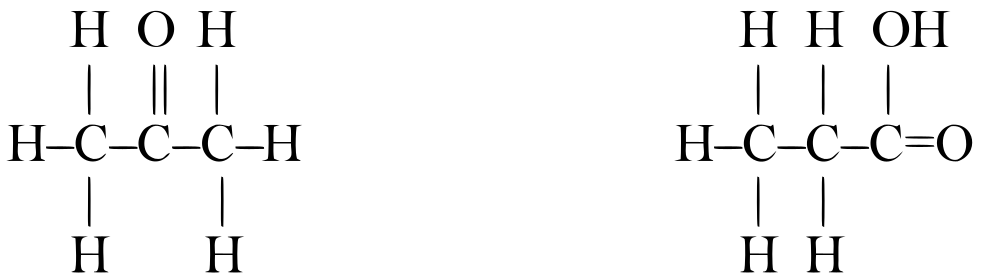
(ii)
What happens when ethanol reacts with acidified potassium dichromate solution ? Write chemical equation for the reaction. Why is this reaction considered an oxidation reaction ?
(iii)
Write chemical equation for the reaction of ethanoic acid with sodium hydroxide.
(i)
Describe method of preparation of soap giving chemical equation for the reaction involved.
(ii)
Explain with diagram the mechanism of the cleansing action of soaps.
Marking-scheme solution
(i) Functional Group: A hetero atom or group of atoms attached to the carbon chain, which gives specific properties to the carbon compounds.
(I) Ketone
(II) Carboxylic acid
(ii) Ethanoic acid is formed
\[\mathrm{C}_{2} \mathrm{H}_{5} \mathrm{OH} \xrightarrow[\text { Acidified } \mathrm{K}_{2} \mathrm{Cr}_{2} \mathrm{O}_{7}+\text { Heat }]{ } \mathrm{CH}_{3} \mathrm{COOH}
\]
oxygen is added to ethanol and converts /oxidises ethanol to ethanoic acid.
(iii) \(\displaystyle \mathrm{CH}_{3} \mathrm{COOH}+\mathrm{NaOH} \longrightarrow \mathrm{CH}_{3} \mathrm{COONa}+\mathrm{H}_{2} \mathrm{O}\)
(B) (i) Soaps are prepared by heating an ester (animal fat / vegetable oil) with a base such as sodium hydroxide.
\[\mathrm{CH}_{3} \mathrm{COOC}_{2} \mathrm{H}_{5} \xrightarrow[\text { Sodium ethanoate }]{\mathrm{NaOH}} \underset{\text { Sol }}{\mathrm{CH}} \mathrm{COONa}+\mathrm{C}_{2} \mathrm{H}_{5} \mathrm{OH}
\]
(ii) Ionic (hydrophilic) end of the soap interacts with water while the carbon chain(hydrophobic) interacts with oil. Thus micelles are formed. Emulsion is formed in the water. Soap micelles pull out the dirt and oil in water.

All Carbon and its Compounds questions2024 question paperNCERT solutions: Carbon and its CompoundsPractice Carbon and its Compounds →
More from Carbon and its Compounds
- The number of single and double bonds present in a molecule of benzene (C_6 H_6) respectively, are:2024
- Which one of the following hydrocarbons is different from the others?2024
- Draw two different possible structures of a saturated hydrocarbon having four carbon atoms in its molecule. What are these two structures of the…2022
- Hydronium ions are formed by the reaction between:2023
- The number of electrons in the outermost shell of the atom of a non-metal can be:2023
- (i) Butane had both Carbon - Carbon bonds as well as Carbon - Hydrogen bonds. Draw its structural formula and state the number of (1) C-H bonds and…2023
- The melting and boiling points of carbon compounds are generally low and they are largely non-conductors of electricity. State two conclusions based…2024
- Select the correct option(s) in the following table:2023
CBSE Class 10 Science past-paper question from the 2024 board exam, with the answer as CBSE’s own marking scheme gives it. Where our answers come from.