✓ Board-verified
Mathematics · 2025 · 4 marks
CBSE 2025 · Region 5 · Set 1 · Q37
In an equilateral triangle of side 10 cm, equilateral triangles of side 1 cm are formed as shown in the figure below, such that there is one triangle…
In an equilateral triangle of side $\displaystyle 10$ cm, equilateral triangles of side $\displaystyle 1$ cm are formed as shown in the figure below, such that there is one triangle in the first row, three triangles in the second row, five triangles in the third row and so on.
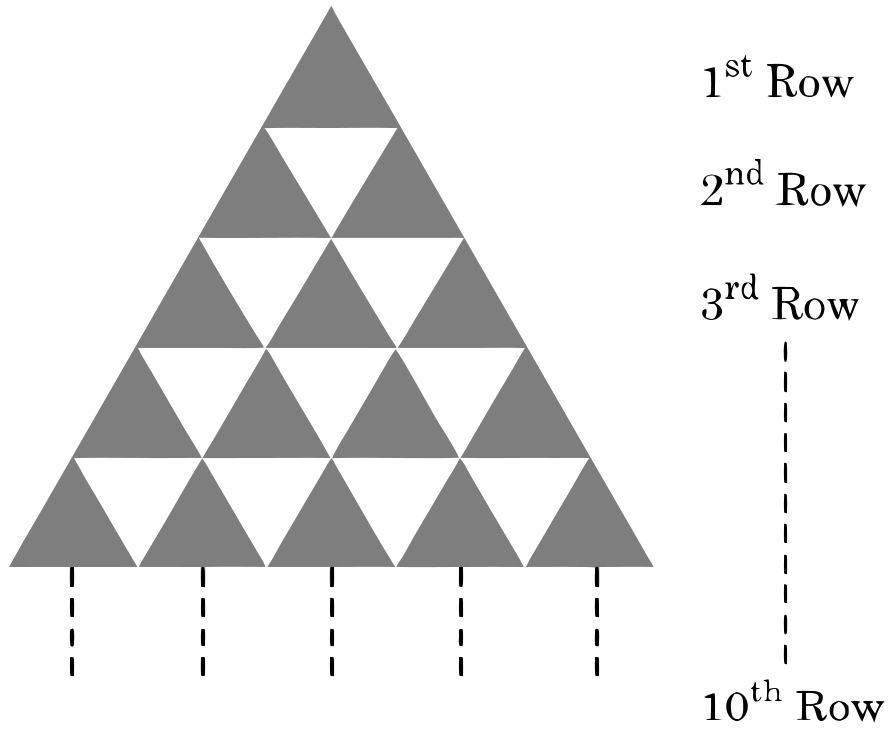
Based on given information, answer the following questions using Arithmetic Progression.
(i)
How many triangles will be there in bottom most row ?
(ii)
How many triangles will be there in fourth row from the bottom?
(iii)
(a)
Find the total number of triangles of side $\displaystyle 1$ cm each till $\displaystyle 8^{\text {th }}$ row.
OR
(b)
How many more number of triangles are there from $\displaystyle 5^{\text {th }}$ row to $\displaystyle 10^{\text {th }}$ row than in first $\displaystyle 4$ rows? Show working.
Marking-scheme solution
Given A.P. is $\displaystyle 1$, $\displaystyle 3$, 5. . .
(i) \(\displaystyle \mathrm{a}_{10}=1+9 \times 2=19\)
(ii) \(\displaystyle \mathrm{a}_{4}(\) from bottom \(\displaystyle )=19+3 \times(-2)=13\)
(iii) (a) \(\displaystyle \mathrm{S}_{8}=\frac{8}{2} \times[2 \times 1+7 \times 2]\)
\[\text { = } 64
\]
(iii) (b) Number of triangles from \(\displaystyle 5^{\text {th }}\) row to \(\displaystyle 10^{\text {th }}\) row \(\displaystyle =\mathrm{S}_{10}-\mathrm{S}_{4}\)
\[\begin{aligned}
& =\frac{10}{2} \times[2 \times 1+9 \times 2]-\frac{4}{2} \times[2 \times 1+3 \times 2] \\
& =84
\end{aligned}
\]
\[\text { Number of triangles in first } \left.4 \text { rows, } \mathrm{S}_{4}=\frac{4}{2} \times[2 \times 1+3 \times 2] .\right] .
\]
\[\text { Required number of triangles }=84-16=68
\]
All Arithmetic Progressions questions2025 question paperNCERT solutions: Arithmetic ProgressionsPractice Arithmetic Progressions →
More from Arithmetic Progressions
- Prerna saves ₹ 32 during the first month, ₹ 36 in the second month and ₹ 40 in the third month. If she continues to save in this manner, in how many…2023
- In an A.P., if the first term (a)=-16 and the common difference (d)=-2, then the sum of first 10 terms is:2024
- The next term of the A.P.: √6, √24, √54 is:2023
- The common difference of the A.P. whose n^th term is given by a_n=3 n+7, is:2023
- If the sum of the first 14 terms of an A.P. is 1050 and the first term is 10, then find the 20^th term and the n^th term. OR The first term of an…2024
- Find the sum of all 3-digit natural numbers which are divisible by 11.2025
- In an A.P., the first term is 32 and the last term is - 10. If the common difference is -2, then find the number of terms and their sum. OR Find the…2026
- The next (4^th ) term of the A.P. √18, √50, √98, … is:2024
CBSE Class 10 Mathematics past-paper question from the 2025 board exam, with the answer as CBSE’s own marking scheme gives it. Where our answers come from.